

-
Condition Check
Based on predefined routing functions (e.g.,if (state.A) → Node X; else → Node Y), decisions on the next node to execute are made in real-time based on conversation state variables (such as user intent, sentiment analysis results). -
Branch Execution
- Single Path Choice: A typical IF-Else pattern (e.g., if the user query contains sensitive words → route to manual review; otherwise → generate automatic reply).
- Multiple Parallel Paths: Supports
if...else if...elsebranches (e.g., triggering both log recording and asynchronous data analysis simultaneously).
Core Features:
-
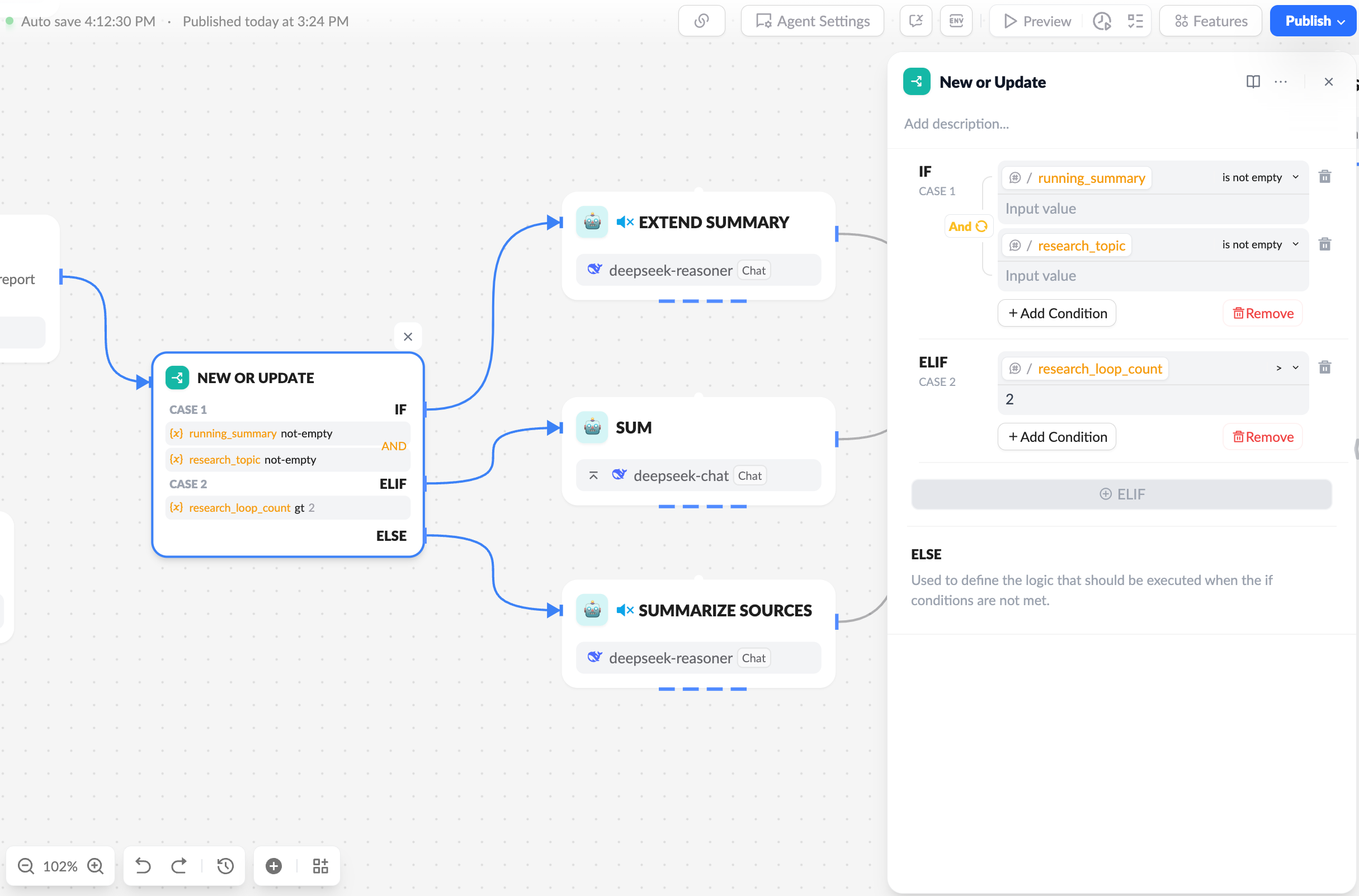
Condition Check: The routing function determines the next action based on multiple conditions, typically checking session variables.
- IF: When all specified conditions are met, a specific action or step is triggered.
- ELIF: If the “IF” condition is not met, it checks other conditions. If those conditions are met, a different set of actions is triggered.
- ELSE: If neither the “IF” nor the “ELIF” conditions are met, a fallback set of actions is executed.
- Dynamic Decision Flow: Based on the results of condition checks, the router decides which branch of the process to follow, dynamically choosing different paths based on input data.
Configuration:
- Condition Settings: Users can set conditions based on actual needs, such as checking whether input parameters are empty, fall within a specific numeric range, or satisfy certain relationships.
- Action Definition: Each condition branch corresponds to an action or series of operations. For example, if the condition is met, a specific task is executed; if not, a fallback task is performed.
Use Cases:
- Dynamic Process Control: Suitable for scenarios where process steps are not fixed and need to be adjusted based on real-time data.
- Multiple Branch Tasks: This routing feature is highly effective when different operations need to be performed based on different input conditions.
- Complex Decision Trees: When a workflow needs to decide the direction based on multiple layers of condition checks, the Router helps manage it efficiently.
Advantages:
- Flexibility: Allows dynamic adjustment of the execution path based on different conditions, adapting to changing requirements.
- Configurability: Users can easily set and modify conditions, quickly responding to business needs.
- Automation: Automatically guides the workflow based on conditions, reducing manual intervention and improving efficiency.