

- Tool selection complexity: The abundance of tools available to agents makes it inefficient to determine which tool to invoke next.
- Context management difficulties: A single agent may struggle to handle complex contextual information effectively.
- Specialization requirements: The system may require expertise in various specialized domains, such as planning, research, or mathematics.
- Modularity: Breaking functionalities into independent agents simplifies development, testing, and maintenance, enhancing system flexibility.
- Specialization: Creating domain-specific expert agents improves overall system performance and efficiency.
- Controllability: Communication between agents can be explicitly managed without relying on implicit mechanisms like function calls.
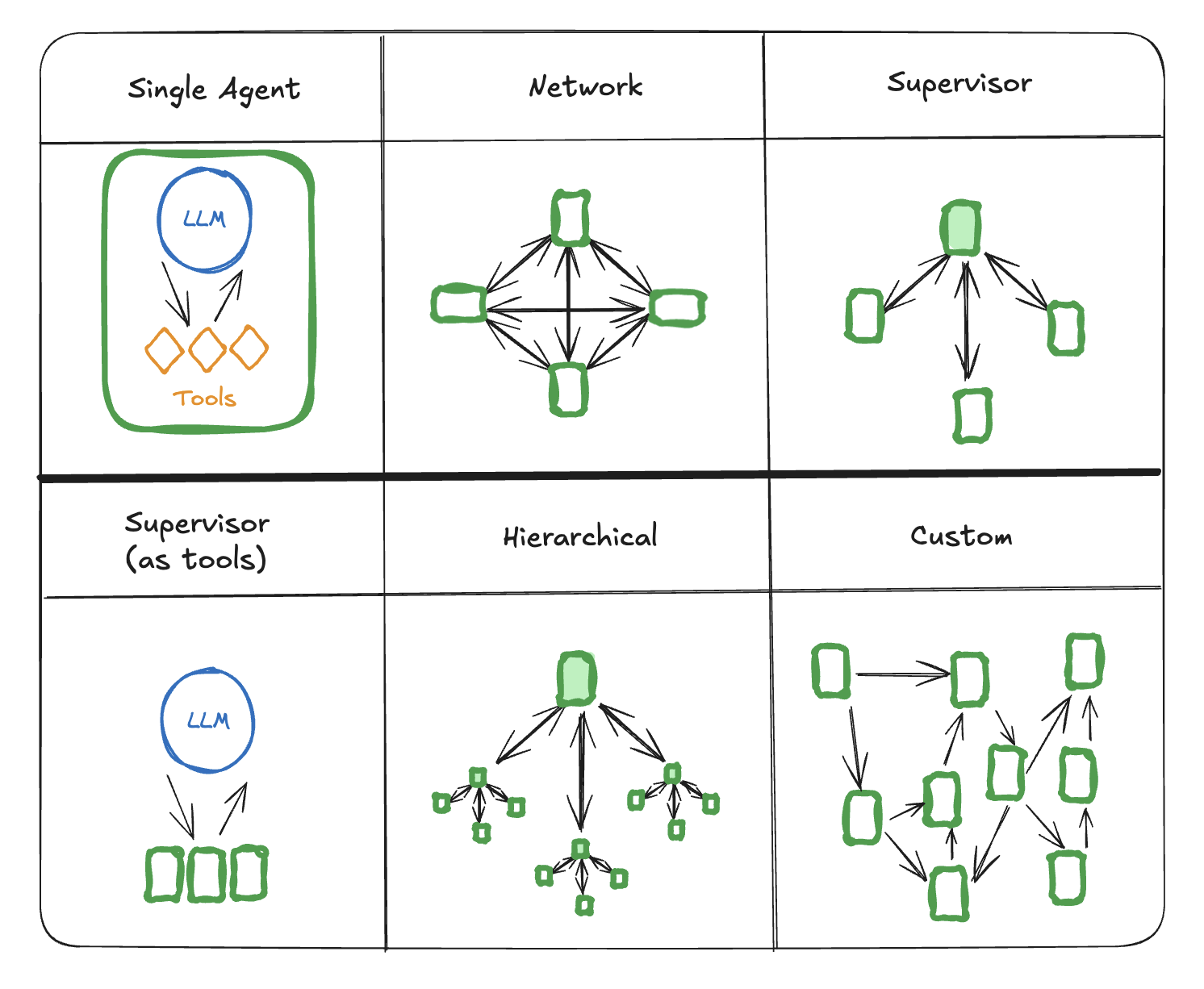
Multi-Agent Architectures
-
Network Architecture
- Each agent can communicate with all other agents.
- Any agent can autonomously determine the target agent to invoke next.
- Suitable for decentralized, high-flexibility scenarios.
-
Supervisor Architecture
- Each agent communicates only with a supervisor agent.
- The supervisor agent makes decisions and determines the next agent to invoke.
- Ideal for centralized management and clear decision-making logic.
-
Hierarchical Architecture
- Builds on the supervisor architecture by introducing multi-level supervisor agents, creating a hierarchy.
- Supports complex control flows and modular management for multi-level business logic.
-
Custom Multi-Agent Workflows
- Each agent communicates only with specific subsets of other agents.
- Some workflows are deterministic, while some agents autonomously decide their next targets.
- Highly flexible, suitable for specific logic or complex business rules.